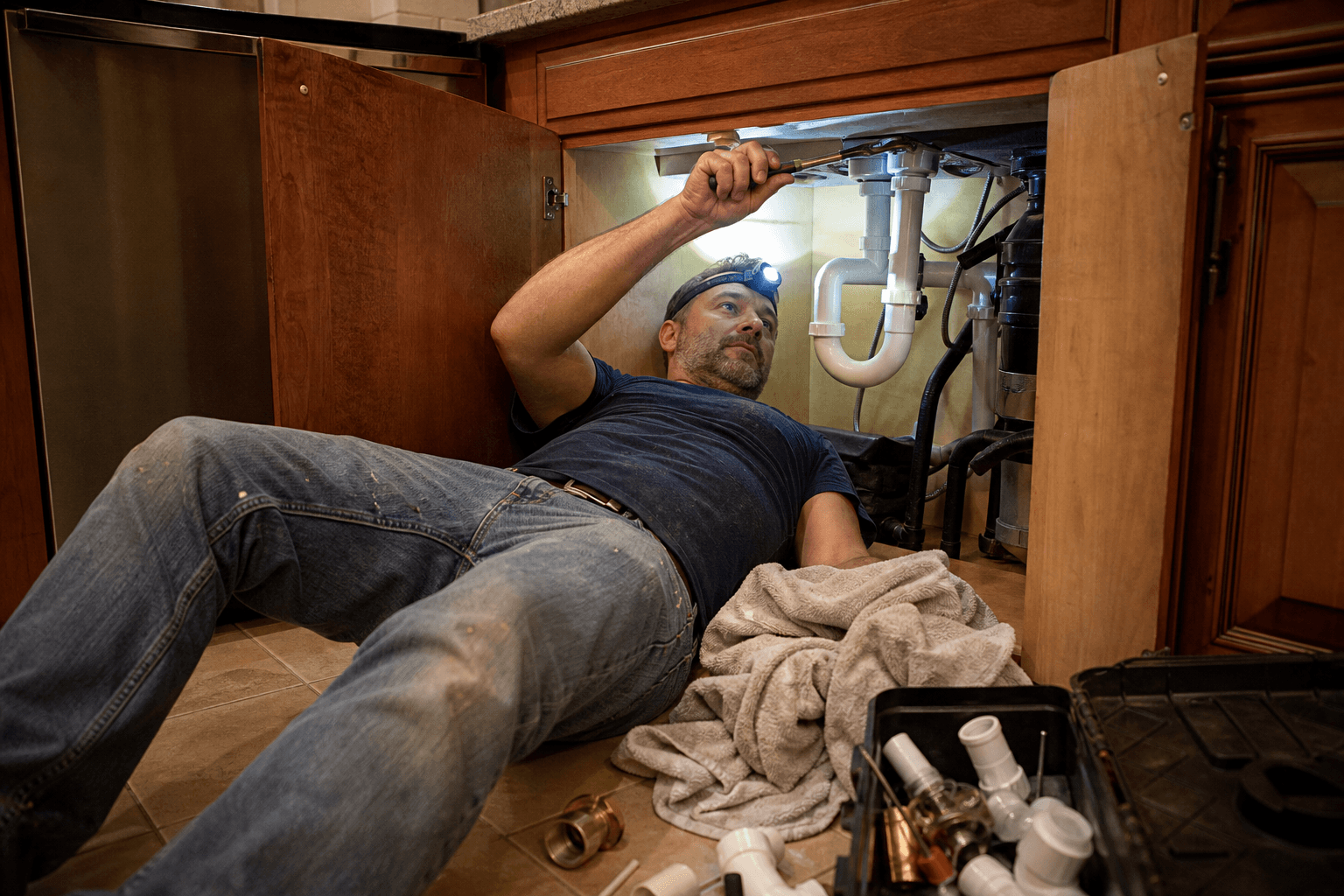
Plumbing is the trade where buyers trust their own judgment least. Most people can't tell a $200 fix from a $2,000 one, and everyone has heard a horror story. That anxiety is exactly why plumbing questions flow to AI: the homeowner wants a neutral referee, and 45% of US consumers used AI tools for local business recommendations in the past year (BrightLocal, 2026). The referee's verdict is narrow, and how narrow depends entirely on which engine you ask. SOCi's 2026 Local Visibility Index found ChatGPT recommended just 1.2% of local brand locations, against 11% for Gemini and 7.4% for Perplexity. The plumbers outside that sliver might as well not exist.
What plumbing questions do homeowners ask AI?
Emergencies lead: "burst pipe who do I call", "water heater leaking is it dangerous". The asker hires within hours. Cost questions follow: water heater replacement, repipe pricing, slab leak repair, sewer line work. These are big-ticket jobs where people compare before calling. And plumbing has the strongest diligence family of any trade: "how do I know a plumber isn't ripping me off", "is [company] legit", "fair price for a water heater install". The companies that answer that anxiety honestly get named as the trustworthy option.
Who does AI name for plumbing jobs?
Mostly the big platforms and the plumbers who look strong on them. The 5W AI Visibility Index (Q1 2026), which tested 320+ prompts across 10 US metros in six local-service categories including plumbing, found AI engines structurally favor national chains and aggregators like Yelp, Angi, Thumbtack, and HomeAdvisor over independent operators. For an independent, the trade adds a tilt of its own: trust evidence outweighs everything else. The plumbers engines name have visible license numbers (state registries are a source engines can check), explicit pricing pages or honest ranges, and review responses that address complaints. An anonymous "call for a quote" site is effectively invisible in the answers, however good its Google rank.
What should a plumber publish to get cited?
- An emergency page with hours, response time, and coverage in plain quotable text. This is the page that wins the burst-pipe answer.
- A priced guide per big-ticket service (water heater replacement, tank vs tankless, repipe, sewer line) with honest ranges plus what moves the price.
- A "how not to get ripped off" explainer that answers the trade's biggest anxiety question; the plumber who writes it gets named as the honest one.
- License number, insurance, and years in business in the footer, matching your state registry entry exactly.
- Review responses. Engines read them as evidence of how you handle problems, and quote the language they find there.
How does a plumber measure AI visibility?
With a fixed set of your market's plumbing questions, asked repeatedly on every engine, tracked as the share of answers that name you. One search is one draw from a distribution, and each engine keeps its own list: Reddit was about 46.7% of Perplexity's top cited domains on commercial queries in 2025 and roughly 24% by January 2026 (Profound), while Ahrefs found 88% of ChatGPT's cited URLs come from its general web-search retrieval rather than news, Reddit, YouTube, or academic sources. Daily per-engine tracking turns the playbook above from faith into a feedback loop: publish, watch the share move, fix the next losing question.