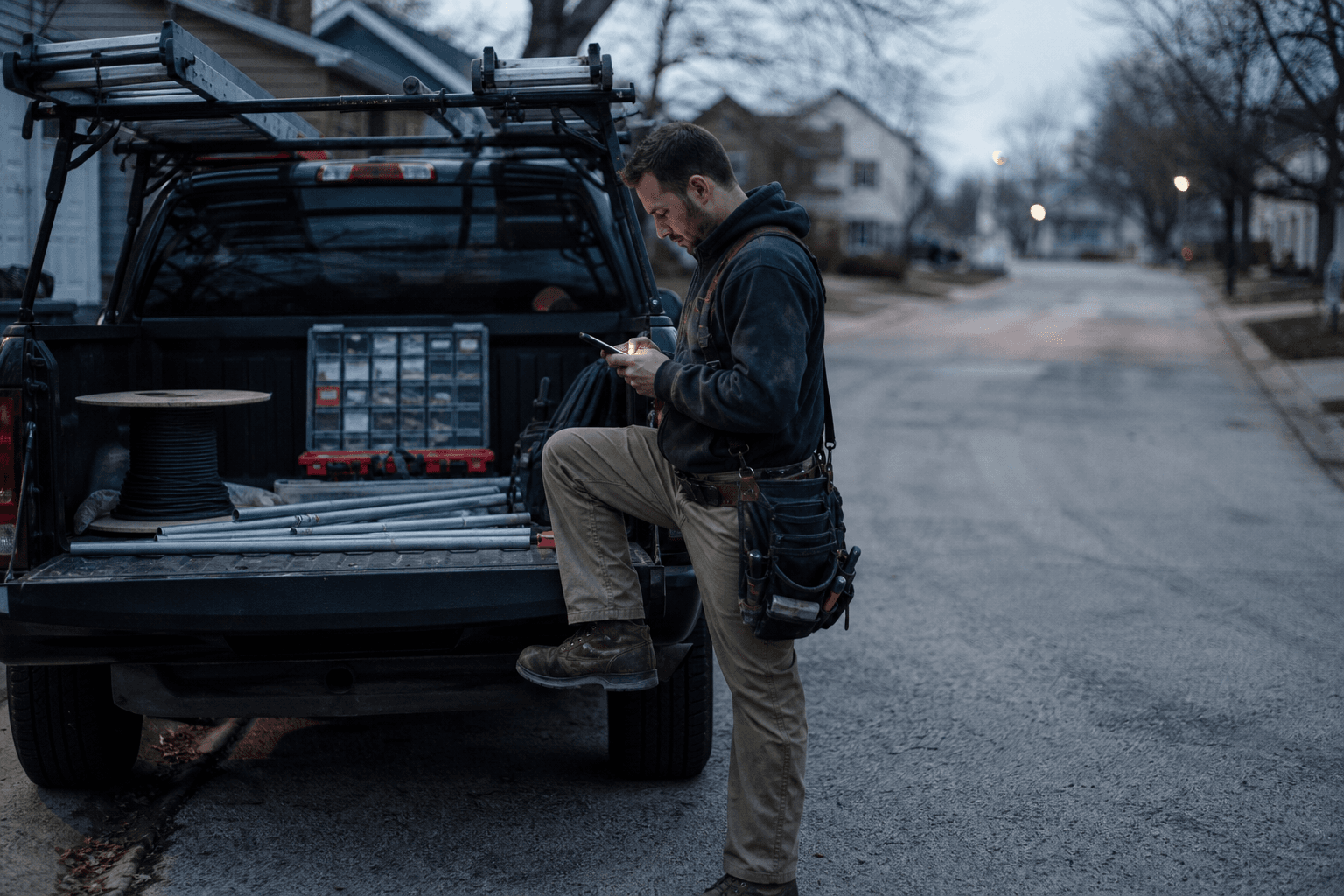
The person asking AI about a general contractor usually isn't a homeowner with a leak. It's an owner planning a build, a developer lining up bids, or a property manager who needs a tenant improvement done. Their question isn't urgent, it's a shortlist question: "which general contractors should I get bids from for a retail buildout in Tampa". That changes everything about how you get named. 45% of US consumers used AI tools like ChatGPT for local business recommendations in the past year (BrightLocal, 2026), and the professional buyers now do the same to build a bid list before they email anyone. Miss the shortlist and you never even get the RFP.
Who's actually asking AI about general contractors?
Rarely the emergency caller, almost always the planner. An owner asks "reputable commercial GCs in Denver for a ground-up office". A developer asks "general contractors experienced with multifamily in Phoenix". A property manager asks "who handles tenant improvements near downtown". These are considered, comparative questions asked weeks before a contract, and the engine answers with a handful of firms and a sentence on each. The sentence is the whole game. If the model can't say what you build and where, it can't put you on the list, however many years you've been in business.
What makes AI put you on the bid shortlist?
Project-type match, stated plainly. Homeowners pick trades on reviews; professional buyers filter on fit. They want the GC who has clearly done their kind of project, at their scale, in their market. So the model looks for legible evidence that you build what they're building. A GC whose site says "we do commercial and residential construction" is unquotable. A GC whose site has a page for tenant improvements, one for ground-up multifamily, and one for restaurant buildouts, each with real projects, hands the engine exactly the sentence it needs to name you for that query and not the others.
What happens when someone asks AI if you're reputable?
This is the second query every GC faces and few prepare for. Once you're on a shortlist, the buyer runs diligence, and increasingly that starts with AI: "is [your company] a reputable contractor", "any complaints about [your company]". The engine assembles an answer from whatever it can find: your license and bond status, your reviews and how you responded to the bad ones, any lawsuits or news, and community threads. You can't fully control that answer, but you can feed it. A licensing and credentials page, honest review responses, and a clean, current site give the model good material to summarize instead of leaving it to guess from a stray complaint.
Who does AI name for general contractor work?
The platforms carry a lot of weight, and so does your own site. Yext, analyzing 6.8 million AI citations across several industries, found 86% came from brand-managed sources, split between owned websites at roughly 44% and managed listings like Google Business Profile and Yelp at roughly 42%. That sample wasn't contractor-specific, but the takeaway travels: the answer is built mostly from things you can control. In Local Dominator's analysis of 267,280 AI citations from its own clients' campaigns, Yelp, Google, Reddit, Facebook, and Angi led the citation counts. That's a vendor convenience sample, so treat it as ordering, not gospel.
What should a general contractor publish to get cited?
- A project-type page for each thing you build, with city, scope, square footage, budget band, and timeline stated in plain text.
- Real, dated project write-ups: the problem, the delivery method, the result, and photos, not a wall of unlabeled images.
- A licensing, bonding, and insurance page with numbers that match the state registry, for the diligence query.
- A service-area page naming the cities and counties you actually build in, so the engine can match you to a location.
- Honest responses to reviews, since the engine reads them as evidence of how you handle a job that went sideways.
How do you track this across engines?
One search won't tell you. Engines disagree on who they name, because they draw from different sources. Profound found ChatGPT and Perplexity share only 11% of the domains they cite. And the pool is small to begin with: SOCi's 2026 Local Visibility Index found ChatGPT recommended just 1.2% of local brand locations, versus 11% for Gemini and 7.4% for Perplexity. SOCi measured multi-location brands rather than contractors, but the shape holds, ChatGPT names almost no one. Track a fixed set of your market's bid and diligence questions across every engine, watch your share of named answers, and fix the project types where you're absent.